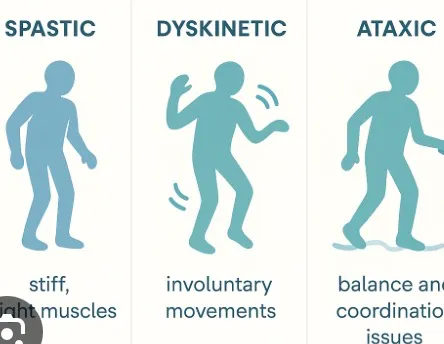
Spastic cerebral palsy has **three main subtypes**, classified by which body parts are affected:
| Subtype | Body Parts Affected | Key Characteristics |
|---------|-------------------|---------------------|
| **Spastic hemiplegia** (or hemiparesis) | One side of the body — arm, hand, and sometimes leg on the same side | Children may have delays in learning to talk, but intelligence is usually normal |
| **Spastic diplegia** (or diparesis) | Mostly the **legs**; arms and face are less severely affected | Intelligence and language skills are usually normal |
| **Spastic quadriplegia** (or quadriparesis) | All **four limbs** (arms and legs), often including torso and face | Most severe form; people usually cannot walk, often have trouble speaking, and may have moderate to severe intellectual disability |
Spastic CP is the **most common type** of cerebral palsy, making up about **70–80%** of all cases. It's marked by **muscle stiffness** (hypertonia) and jerky or repeated movements.
| Subtype | Body Parts Affected | Key Characteristics |
|---------|-------------------|---------------------|
| **Spastic hemiplegia** (or hemiparesis) | One side of the body — arm, hand, and sometimes leg on the same side | Children may have delays in learning to talk, but intelligence is usually normal |
| **Spastic diplegia** (or diparesis) | Mostly the **legs**; arms and face are less severely affected | Intelligence and language skills are usually normal |
| **Spastic quadriplegia** (or quadriparesis) | All **four limbs** (arms and legs), often including torso and face | Most severe form; people usually cannot walk, often have trouble speaking, and may have moderate to severe intellectual disability |
Spastic CP is the **most common type** of cerebral palsy, making up about **70–80%** of all cases. It's marked by **muscle stiffness** (hypertonia) and jerky or repeated movements.
Keywords