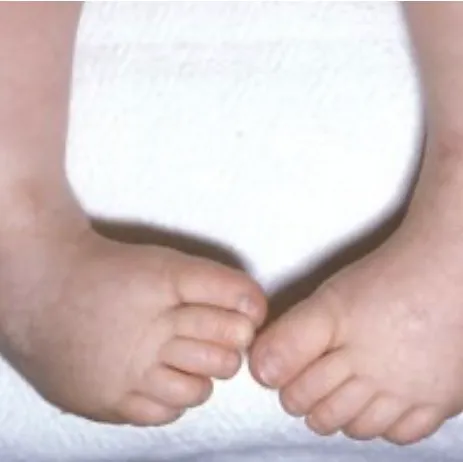
**Clubfoot** (medical name: *congenital talipes equinovarus*) is a common birth condition where a baby’s foot is turned inward and downward, fixed in an unusual position.
### Key facts
| Aspect | Details |
|--------|---------|
| **How common** | About 1 in 1, 000 babies; affects boys twice as often as girls |
| **One or both feet** | ~60% affect only one foot; 40% affect both |
| **Cause** | Usually unknown (*idiopathic*); likely genetic (runs in families) |
| **Physical cause** | Shortened-tight Achilles tendon; smaller calf muscles |
| **Pain** | Not painful in babies, but causes problems when standing-walking if untreated |
| **Detection** | Often seen on prenatal ultrasound (~20 weeks); confirmed at birth
![Bilateral clubfoot in an infant, showing feet turned inward and upward]
### Treatment (very successful)
Clubfoot **won't correct on its own** – treatment must start within 1–3 weeks after birth for best results.
**Primary method: Ponseti method** (non-surgical, 90% successful)
- **Phase 1**: Gentle stretching + weekly plaster casts for several weeks
- **Phase 2**: Minor procedure to lengthen Achilles tendon (often needed)
- **Phase 3**: Bracing (foot abduction brace like Denis Browne bar) to prevent recurrence
![Foot abduction brace (Denis Browne bar) used in clubfoot treatment]
Without treatment, children may walk on the side-top of their foot. With early Ponseti treatment, most children walk normally and have no long-term issues.
### Key facts
| Aspect | Details |
|--------|---------|
| **How common** | About 1 in 1, 000 babies; affects boys twice as often as girls |
| **One or both feet** | ~60% affect only one foot; 40% affect both |
| **Cause** | Usually unknown (*idiopathic*); likely genetic (runs in families) |
| **Physical cause** | Shortened-tight Achilles tendon; smaller calf muscles |
| **Pain** | Not painful in babies, but causes problems when standing-walking if untreated |
| **Detection** | Often seen on prenatal ultrasound (~20 weeks); confirmed at birth
![Bilateral clubfoot in an infant, showing feet turned inward and upward]
### Treatment (very successful)
Clubfoot **won't correct on its own** – treatment must start within 1–3 weeks after birth for best results.
**Primary method: Ponseti method** (non-surgical, 90% successful)
- **Phase 1**: Gentle stretching + weekly plaster casts for several weeks
- **Phase 2**: Minor procedure to lengthen Achilles tendon (often needed)
- **Phase 3**: Bracing (foot abduction brace like Denis Browne bar) to prevent recurrence
![Foot abduction brace (Denis Browne bar) used in clubfoot treatment]
Without treatment, children may walk on the side-top of their foot. With early Ponseti treatment, most children walk normally and have no long-term issues.
Keywords