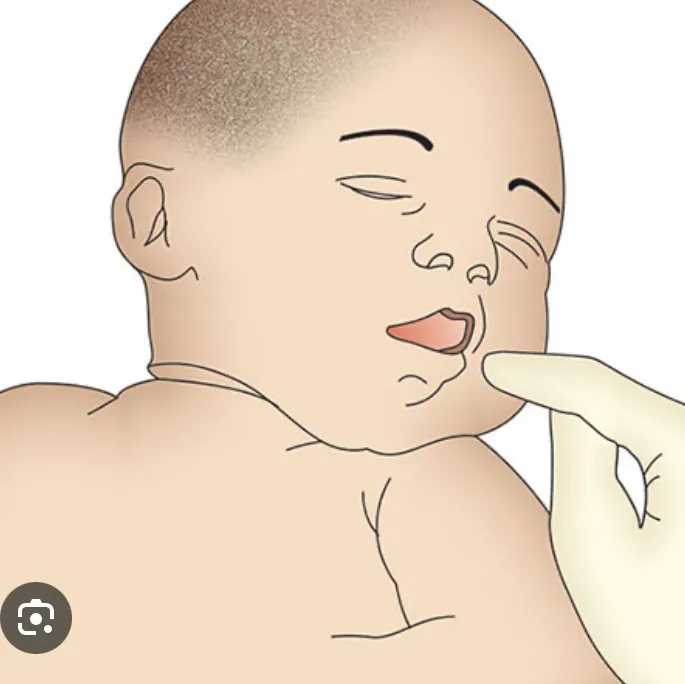
The rooting reflex is an automatic, survival‑oriented movement in newborns that helps them find a nipple (breast or bottle) and start feeding when their cheek or mouth area is touched.
## What it looks like
- When the corner of a baby’s mouth or cheek is gently stroked, the baby:
- Turns their head toward the touch
- Opens their mouth wide
- May thrust the tongue forward as if “searching” for a nipple.
## Why it matters
- It’s a **primitive (brainstem) reflex** present from late pregnancy (around 28 weeks’ gestation) and is crucial for early feeding and survival.It works together with the **sucking reflex**: rooting helps the baby locate the nipple; once the nipple touches the roof of the mouth, sucking begins automatically.
- Parents and caregivers often notice rooting when the baby is **hungry**, so it also acts as a hunger cue.
## When it appears and disappears
- Present at birth (even in many preterm babies, though it may be weaker).
- Typically **fades between 4 and 6 months** as the brain’s frontal lobes mature and voluntary feeding skills develop
## When to talk to a doctor
Mention it to your pediatrician if you notice:
- The reflex is **very weak or absent** in a newborn, especially with poor feeding or difficulty latching.
- The reflex **persists strongly beyond 6 months**, especially with other abnormal reflexes, excessive drooling, or feeding difficulties (trouble swallowing-chewing), which can sometimes signal neurological issues.
## What it looks like
- When the corner of a baby’s mouth or cheek is gently stroked, the baby:
- Turns their head toward the touch
- Opens their mouth wide
- May thrust the tongue forward as if “searching” for a nipple.
## Why it matters
- It’s a **primitive (brainstem) reflex** present from late pregnancy (around 28 weeks’ gestation) and is crucial for early feeding and survival.It works together with the **sucking reflex**: rooting helps the baby locate the nipple; once the nipple touches the roof of the mouth, sucking begins automatically.
- Parents and caregivers often notice rooting when the baby is **hungry**, so it also acts as a hunger cue.
## When it appears and disappears
- Present at birth (even in many preterm babies, though it may be weaker).
- Typically **fades between 4 and 6 months** as the brain’s frontal lobes mature and voluntary feeding skills develop
## When to talk to a doctor
Mention it to your pediatrician if you notice:
- The reflex is **very weak or absent** in a newborn, especially with poor feeding or difficulty latching.
- The reflex **persists strongly beyond 6 months**, especially with other abnormal reflexes, excessive drooling, or feeding difficulties (trouble swallowing-chewing), which can sometimes signal neurological issues.
Keywords