Direct answer: Echolalia in autism is usually categorized by timing (immediate vs delayed) and by communicative function (interactive-functional vs non‑interactive-nonfunctional), with additional subtypes such as mitigated-partial echolalia that show evidence of language processing.
Types by timing
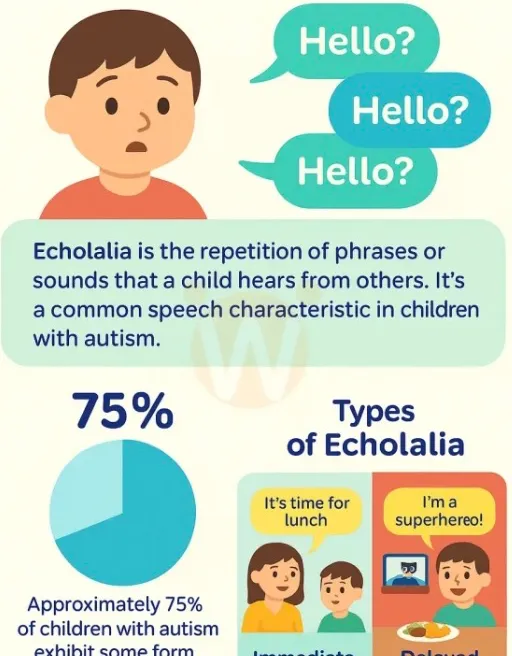
- Immediate echolalia: repeating words or phrases right after hearing them; often helps the person process language and take turns in conversation.
- Delayed echolalia: repeating phrases after a time gap (minutes, hours, days or longer), often drawn from remembered sources (TV, songs, past conversations) and sometimes used for comfort or to express emotion.
Types by function (how the repetition is used)
- Functional-interactive echolalia: echoed language used with communicative intent (requests, affirmations, topic initiation, turn‑taking). This form shows that repetition can serve meaningful social or pragmatic purposes.[6]
- Non‑interactive-nonfunctional echolalia: repetition without apparent communicative intent, often serving self‑stimulatory, calming, or rehearsal roles.
Forms that show developmental language processing
- Mitigated (or transformed) echolalia: the repeated phrase is altered (shortened, grammatically changed, or combined with original speech), indicating emerging language comprehension and generative use of language.
- Exact-precise echolalia: verbatim repetition of others’ words or sentences, which may be immediate or delayed.
How clinicians commonly describe or classify echolalia
- Clinicians and researchers often describe echolalia along two axes — timing (immediate vs delayed) and function (interactive vs non‑interactive) — and note whether utterances are exact or mitigated to assess language development and intervention needs.
Practical implications (brief)
- Recognize purpose before trying to eliminate it: many echolalic utterances serve communication, regulation, or learning functions.
- Assessment should note timing, source (where the phrase came from), function, and whether the speech is transformed — this guides intervention that builds on echolalia rather than only suppressing it.
If you’d like, I can:
- Give examples of each type with short sample dialogues, or
- Summarize recommended strategies therapists use to respond to each type (e.g., modeling short functional phrases, expanding mitigated utterances).
Types by timing
- Immediate echolalia: repeating words or phrases right after hearing them; often helps the person process language and take turns in conversation.
- Delayed echolalia: repeating phrases after a time gap (minutes, hours, days or longer), often drawn from remembered sources (TV, songs, past conversations) and sometimes used for comfort or to express emotion.
Types by function (how the repetition is used)
- Functional-interactive echolalia: echoed language used with communicative intent (requests, affirmations, topic initiation, turn‑taking). This form shows that repetition can serve meaningful social or pragmatic purposes.[6]
- Non‑interactive-nonfunctional echolalia: repetition without apparent communicative intent, often serving self‑stimulatory, calming, or rehearsal roles.
Forms that show developmental language processing
- Mitigated (or transformed) echolalia: the repeated phrase is altered (shortened, grammatically changed, or combined with original speech), indicating emerging language comprehension and generative use of language.
- Exact-precise echolalia: verbatim repetition of others’ words or sentences, which may be immediate or delayed.
How clinicians commonly describe or classify echolalia
- Clinicians and researchers often describe echolalia along two axes — timing (immediate vs delayed) and function (interactive vs non‑interactive) — and note whether utterances are exact or mitigated to assess language development and intervention needs.
Practical implications (brief)
- Recognize purpose before trying to eliminate it: many echolalic utterances serve communication, regulation, or learning functions.
- Assessment should note timing, source (where the phrase came from), function, and whether the speech is transformed — this guides intervention that builds on echolalia rather than only suppressing it.
If you’d like, I can:
- Give examples of each type with short sample dialogues, or
- Summarize recommended strategies therapists use to respond to each type (e.g., modeling short functional phrases, expanding mitigated utterances).
Keywords