**Speech sound disorders (SSDs)** are communication disorders in which children (and sometimes adults) cannot say sounds and words like others their age, making their speech difficult to understand.
### Main Types
| Type | Description | Example |
|------|-------------|---------|
| **Articulation disorder** | Difficulty physically producing specific speech sounds; may drop, add, distort, or substitute sounds | Saying "puhlay" instead of "play" (adding a sound) |
| **Phonological process disorder** | Uses patterned error rules that are normal in young children but persist past the expected age | Saying "wain" instead of "rain" (substituting -w-for -r
| **Combined disorder** | Mix of both articulation and phonological process problems | Multiple error types present
### Common Causes
- **Developmental**: Born with the disorder (most common)
- **Motor-neurological**: Childhood apraxia of speech, dysarthria
- **Structural**: Cleft lip-palate, oral anatomy differences
- **Sensory-perceptual**: Hearing loss affecting sound perception
- **Idiopathic**: No identifiable cause
### Key Signs & Symptoms
- Substituting sounds ("wain" for "rain")
- Distorting sounds ("thoap" for "soap")
- Adding or leaving out sounds ("at" instead of "bat")
- Simplifying words ("baba" for "bottle")
- Inconsistent speech (saying "go" differently each time)
- Lisping or difficulty with -r-sound
- Speech unclear to unfamiliar listeners
### Diagnosis & Treatment
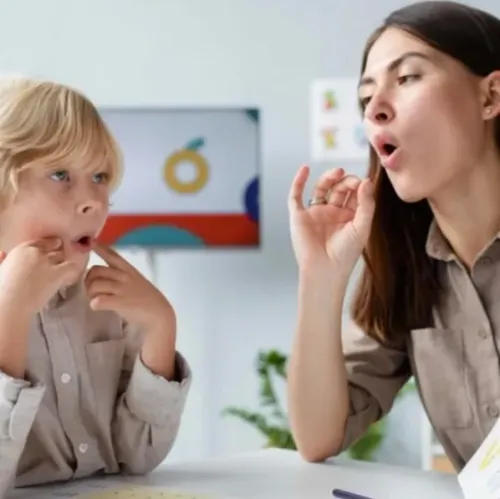
**Diagnosis**: A speech-language pathologist (SLP) assesses speech through testing, language samples, and observation to determine if errors are age-appropriate.
**Treatment**: Speech-language therapy helps children learn to produce sounds correctly, recognize errors, and practice in sentences. Most children improve significantly with early intervention.
SSDs typically start in early childhood and differ from language disorders (which involve understanding-using language, not sound production).
### Main Types
| Type | Description | Example |
|------|-------------|---------|
| **Articulation disorder** | Difficulty physically producing specific speech sounds; may drop, add, distort, or substitute sounds | Saying "puhlay" instead of "play" (adding a sound) |
| **Phonological process disorder** | Uses patterned error rules that are normal in young children but persist past the expected age | Saying "wain" instead of "rain" (substituting -w-for -r
| **Combined disorder** | Mix of both articulation and phonological process problems | Multiple error types present
### Common Causes
- **Developmental**: Born with the disorder (most common)
- **Motor-neurological**: Childhood apraxia of speech, dysarthria
- **Structural**: Cleft lip-palate, oral anatomy differences
- **Sensory-perceptual**: Hearing loss affecting sound perception
- **Idiopathic**: No identifiable cause
### Key Signs & Symptoms
- Substituting sounds ("wain" for "rain")
- Distorting sounds ("thoap" for "soap")
- Adding or leaving out sounds ("at" instead of "bat")
- Simplifying words ("baba" for "bottle")
- Inconsistent speech (saying "go" differently each time)
- Lisping or difficulty with -r-sound
- Speech unclear to unfamiliar listeners
### Diagnosis & Treatment
**Diagnosis**: A speech-language pathologist (SLP) assesses speech through testing, language samples, and observation to determine if errors are age-appropriate.
**Treatment**: Speech-language therapy helps children learn to produce sounds correctly, recognize errors, and practice in sentences. Most children improve significantly with early intervention.
SSDs typically start in early childhood and differ from language disorders (which involve understanding-using language, not sound production).
Keywords