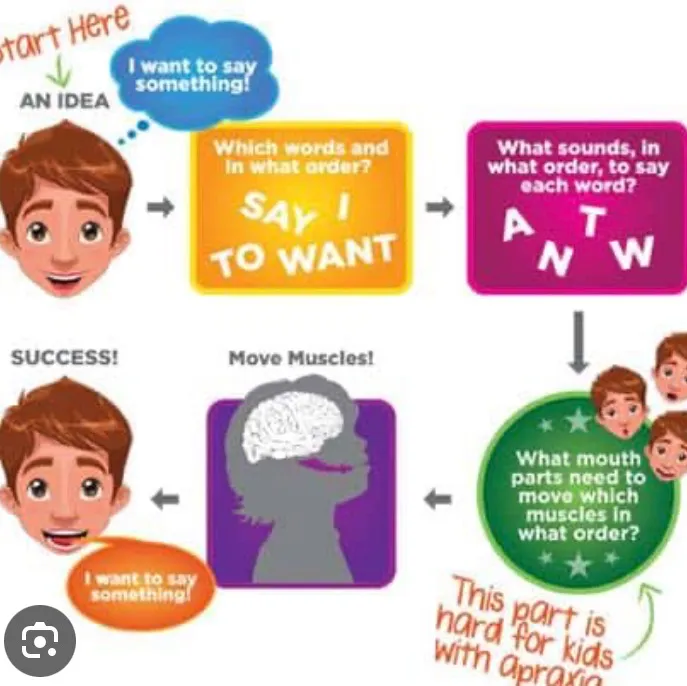
Childhood apraxia of speech (CAS) is a neurological motor speech disorder in which the brain has difficulty planning and coordinating the precise movements needed for clear speech, despite normal muscle strength.
## Core diagnostic characteristics
Experts typically identify CAS by three core features that appear together:
- **Inconsistent speech sound errors**: The child may say the same word differently each time (e.g., “banana” → “buh-NA-nuh, ” “BUH-na-nuh, ” “buh-nuh-NA”).
- **Disrupted transitions between sounds and syllables**: Speech sounds “choppy, ” with lengthened or broken transitions, pauses between syllables, or “syllable segregation” (e.g., “ba…na…na”).
- **Abnormal prosody (stress, rhythm, intonation)**: Wrong stress in words, equal stress on all syllables, or a “robotic, ” “monotone, ” or “accented” speech pattern.
## Common speech and oral-motor signs
Other frequent characteristics include:
- **Groping-searching movements**: Visible jaw, lip, or tongue movements as the child “searches” for the right mouth position before speaking.
- **Difficulty imitating speech**: Trouble copying simple words, sounds, or mouth movements on request.
- **More errors on longer-complex words**: Clearer on single sounds or short words; much harder on multisyllabic words and longer phrases.
- **Sound distortions, deletions, and substitutions**: Consonant and vowel errors; leaving out sounds; mixing up sound order; voicing errors (e.g., “pie” sounding like “bye”).
- **Limited sound repertoire**: Uses only a few consonants-vowels; may rely on vowels, grunts, or single syllables to communicate.
- **Slow rate of speech and poor coarticulation**: Speech is slower than expected; smooth blending of sounds is reduced.
- **Low intelligibility**, especially to unfamiliar listeners, even when the child knows what they want to say.
## Early developmental clues
In babies and toddlers, signs can include:
- Reduced or late babbling-cooing (7–12 months)
- First words later than expected (often after 12–18 months)
- Very limited range of early sounds
- Feeding difficulties (chewing, sucking, blowing) due to oral-motor planning issues
## Core diagnostic characteristics
Experts typically identify CAS by three core features that appear together:
- **Inconsistent speech sound errors**: The child may say the same word differently each time (e.g., “banana” → “buh-NA-nuh, ” “BUH-na-nuh, ” “buh-nuh-NA”).
- **Disrupted transitions between sounds and syllables**: Speech sounds “choppy, ” with lengthened or broken transitions, pauses between syllables, or “syllable segregation” (e.g., “ba…na…na”).
- **Abnormal prosody (stress, rhythm, intonation)**: Wrong stress in words, equal stress on all syllables, or a “robotic, ” “monotone, ” or “accented” speech pattern.
## Common speech and oral-motor signs
Other frequent characteristics include:
- **Groping-searching movements**: Visible jaw, lip, or tongue movements as the child “searches” for the right mouth position before speaking.
- **Difficulty imitating speech**: Trouble copying simple words, sounds, or mouth movements on request.
- **More errors on longer-complex words**: Clearer on single sounds or short words; much harder on multisyllabic words and longer phrases.
- **Sound distortions, deletions, and substitutions**: Consonant and vowel errors; leaving out sounds; mixing up sound order; voicing errors (e.g., “pie” sounding like “bye”).
- **Limited sound repertoire**: Uses only a few consonants-vowels; may rely on vowels, grunts, or single syllables to communicate.
- **Slow rate of speech and poor coarticulation**: Speech is slower than expected; smooth blending of sounds is reduced.
- **Low intelligibility**, especially to unfamiliar listeners, even when the child knows what they want to say.
## Early developmental clues
In babies and toddlers, signs can include:
- Reduced or late babbling-cooing (7–12 months)
- First words later than expected (often after 12–18 months)
- Very limited range of early sounds
- Feeding difficulties (chewing, sucking, blowing) due to oral-motor planning issues
Keywords