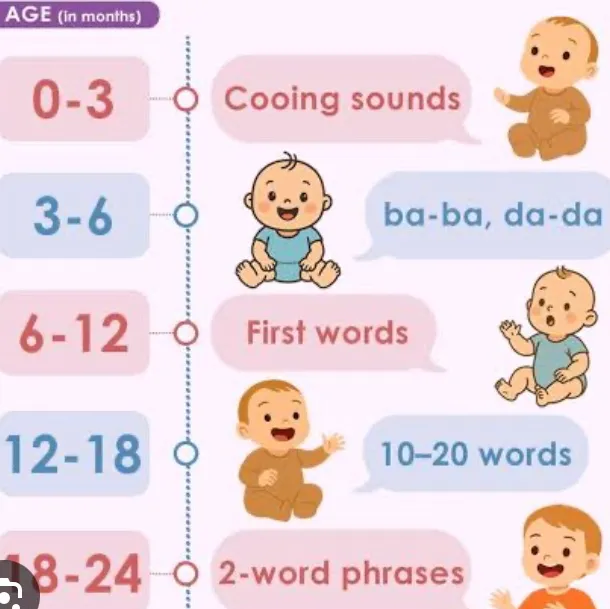
A child’s speech development is best judged by their **age, understanding, gestures, sounds, and words**—not pronunciation alone. Milestones are approximate; children develop at different rates, but missing several skills or losing previously acquired skills deserves evaluation.
## Quick milestone guide
- **Birth–3 months:** Quiets or smiles when spoken to; makes sounds and reacts to voices.
- **4–6 months:** Babbles and produces varied vowel and consonant sounds.
- **7–12 months:** Responds to their name, uses gestures such as pointing or waving, imitates sounds, and may say one or two words around 12 months.
- **13–18 months:** Understands simple directions and uses several meaningful words.
- **19–24 months:** Uses at least about 50 words and combines two words, such as “more milk” or “go outside.”
- **2–3 years:** Uses frequent word combinations, asks for help, follows two-step directions, and is increasingly understandable.
- **3–4 years:** Speaks in longer sentences, answers simple questions, tells about events or stories, and is understood by unfamiliar listeners much of the time.
- **4–5 years:** Uses grammatically developed sentences, tells a simple story, and communicates clearly in conversation.
## When to seek help
Talk with your child’s pediatrician or a speech-language pathologist if your child:
- Does not respond to sounds or their name.
- Rarely babbles, gestures, points, or makes eye contact.
- Has no meaningful words by around 16 months.
- Is not combining two words by around 24 months.
- Is difficult for familiar people to understand at age 3, or for most people to understand at age 4.
- Loses speech, language, or social skills at any age.
A hearing test is often important because hearing difficulties can affect speech and language development. Do not wait for a child to “grow out of it” if you are concerned—early assessment can clarify whether support is needed.
## Quick milestone guide
- **Birth–3 months:** Quiets or smiles when spoken to; makes sounds and reacts to voices.
- **4–6 months:** Babbles and produces varied vowel and consonant sounds.
- **7–12 months:** Responds to their name, uses gestures such as pointing or waving, imitates sounds, and may say one or two words around 12 months.
- **13–18 months:** Understands simple directions and uses several meaningful words.
- **19–24 months:** Uses at least about 50 words and combines two words, such as “more milk” or “go outside.”
- **2–3 years:** Uses frequent word combinations, asks for help, follows two-step directions, and is increasingly understandable.
- **3–4 years:** Speaks in longer sentences, answers simple questions, tells about events or stories, and is understood by unfamiliar listeners much of the time.
- **4–5 years:** Uses grammatically developed sentences, tells a simple story, and communicates clearly in conversation.
## When to seek help
Talk with your child’s pediatrician or a speech-language pathologist if your child:
- Does not respond to sounds or their name.
- Rarely babbles, gestures, points, or makes eye contact.
- Has no meaningful words by around 16 months.
- Is not combining two words by around 24 months.
- Is difficult for familiar people to understand at age 3, or for most people to understand at age 4.
- Loses speech, language, or social skills at any age.
A hearing test is often important because hearing difficulties can affect speech and language development. Do not wait for a child to “grow out of it” if you are concerned—early assessment can clarify whether support is needed.
Keywords