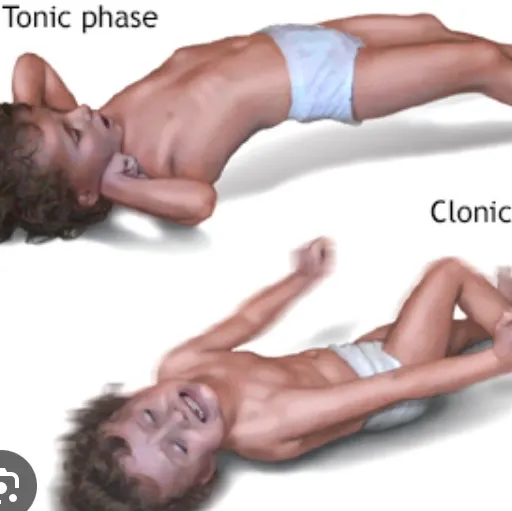
A **tonic-clonic seizure** causes sudden stiffening of the body (tonic phase), followed by rhythmic jerking (clonic phase), often with loss of awareness. In a child, a first seizure—or a seizure lasting **5 minutes or longer**—needs urgent medical assessment.
## During a seizure
- Stay calm and **time the seizure**.
- Protect the child from injury: move hard-sharp objects away and cushion their head.
- Loosen tight clothing around the neck.
- Do **not** restrain their movements.
- Do **not** put anything in their mouth, including food, water, fingers, or medicine.
- When jerking stops, gently roll them onto their side in the recovery position and monitor breathing.
- Stay with them until they are fully awake and reassured.
Call emergency services immediately if the seizure lasts 5 minutes or more, repeats without full recovery, breathing remains abnormal, the child is injured, the seizure occurs in water, or this is their first known seizure. Convulsive status epilepticus is treated as an emergency; children with an individualized rescue-medication plan should follow it exactly.
## Medical assessment
A paediatrician or paediatric neurologist should determine whether the event was epileptic, what seizure type it was, and the cause. Assessment commonly includes a detailed witness history and examination; an EEG may help classify suspected epilepsy, and MRI is often offered after an epilepsy diagnosis unless a clearly idiopathic generalized or self-limited syndrome is present.For confirmed generalized tonic-clonic seizures, medication choices are individualized by a specialist; NICE lists lamotrigine, levetiracetam, and sodium valproate among first-line monotherapy options, with important safety restrictions around valproate. Never start, stop, or change antiseizure medication without the child’s epilepsy clinician.
## Role of physiotherapy
**Physiotherapy does not stop or cure seizures.** Its role is to improve function and safety when seizures, an underlying neurological condition, injury, medication effects, or developmental difficulties affect movement or everyday participation.
A paediatric physiotherapist may help with:
- **Motor development:** sitting, standing, walking, balance, coordination, and play skills.
- **Muscle and joint problems:** stretching, positioning, strength, range of motion, and prevention of contractures when mobility is limited.
- **Falls and injury reduction:** safe transfers, gait training, home-school risk assessment, and advice on protective equipment only when clinically appropriate.
- **After-effects of seizures:** graded return to walking, endurance, confidence, and activity after injury, prolonged admission, or deconditioning.
- **Caregiver and school training:** safe positioning, handling, participation in PE, and a written seizure first-aid plan.
- **Associated diagnoses:** rehabilitation for children with cerebral palsy, brain injury, genetic conditions, or developmental delay who also have epilepsy.
## Safe exercise principles
Regular age-appropriate physical activity is usually beneficial, but the plan should be individualized around seizure control, triggers, supervision needs, and the child’s abilities. Avoid unsupervised swimming or bathing; use close, informed supervision around water, heights, cycling-road traffic, and climbing activities.
A practical physiotherapy goal might be: “Improve balance and leg strength so the child can walk safely at school and recover confidence after falls, ” rather than attempting to treat the seizure itself.
## When to seek specialist help
Ask for referral to a **paediatric neurologist-epilepsy team** and paediatric physiotherapist if the child has frequent seizures, developmental regression, persistent weakness or balance problems, repeated falls-injuries, difficulty walking, abnormal stiffness, pain, or reduced participation at home or school. NICE guidance emphasizes specialist assessment and individualized safety education after suspected seizures.
Keywords