Birth to 5 Years Developmental Milestones
Your guide to learning, development and growing up, for your child
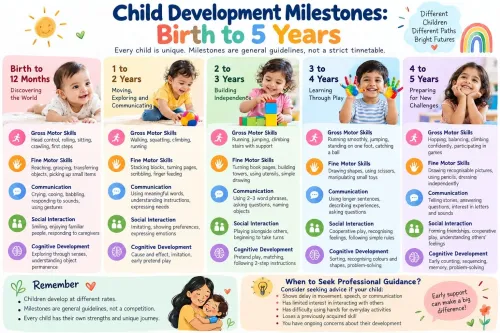
One of the best things about being a parent is seeing your child grow up. Every new skill is a cause for happiness and pride. From that first smile, to those first words, to those exciting first steps. As parents, as we move along we wonder, “Is my child developing normally?
Child development in all areas gross motor , fine motor , communication , social interaction and cognitive . These milestones help parents know how their child is doing, encourage learning at home, and when to get help.
Remember each child is individual. Milestones are general guidelines of development, not a race or schedule to be followed.
1. Birth to 12 Months: Discovering the World
Babies grow fast in the first year of life. They begin to notice the things around them, they respond to familiar faces, and they start the process of moving and speaking.
Motor Skills:They learn to control their heads, roll over, to sit up, first with help, then by themselves. Some start crawling, pulling themselves up or taking their first steps at the end of the first year. But crawling is not a milestone every baby will reach the same way.
Fine motor skills: A baby’s first grasp is a whole hand grip. They will start to grab toys, move things from one hand to the other and start to pick up small objects with their thumb and fingers with better co-ordination.
Communication: Early communication includes crying, cooing, babbling, and responding to familiar voices. Babies may turn their heads toward sounds, know their names, or use gestures such as reaching their arms toward a caregiver.
SocialInteraction: Important early social skills include smiling at familiar faces, enjoying playful interactions, and responding to caregivers. Babies are becoming more and more communicative and interested in what is happening around them.
Cognitive Development: Learning Through the Senses They examine toys by looking at them, touching them, shaking them and sometimes putting them in their mouths. They learn over time that there are objects and people there when they can’t see them.
2. Moving, Exploring and Communicating 1-2 Years
Second year can be an exciting time of change. Toddlers grow more independent and curious.
Motor Skills : As children get better at balancing, bending down to pick up toys, getting on low furniture and trying to run, many learn to walk.
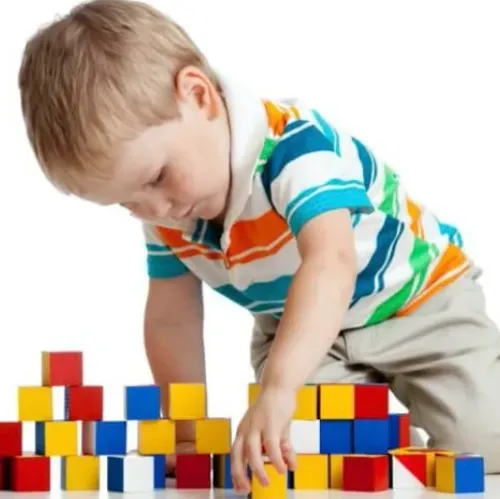
Fine Motor Development: Toddlers learn to stack blocks, turn pages in books, scribble with crayons, and eat with their fingers. They learn to master their hand by slow degrees.
Communication:They may begin to use words that have meaning and then string words together to say what they want. can say the common orders and the names of common objects.
SocialInteraction:Toddlers like familiar faces and copy activities at home. They are beginning to develop likes and dislikes and feelings, but sharing and waiting and dealing with frustration can still be difficult.
Intellectual Development: Kids learn cause and effect, imitation of actions, and exploration of objects. You might see some simple pretend play (e.g., pretending to talk on a toy phone).
3. 2-3 Years: Developing independence
Children between two and three years are usually more active, expressive and interested in doing things themselves.
Motor Skills: Children usually improve at walking and running and begin to jump on two feet and try to climb stairs with help or supervision.
Fine motor skills: Turns pages of individual books, builds taller towers of blocks, uses simple utensils, and copies basic lines or scribbles.
Communication: Children start to string words together into little phrases or sentences and their vocabulary increases. They start asking questions. They name things that they know. They express their ideas more clearly.
Social Interaction: They may start out by playing with other children and then move on to simple shared play. They begin to learn how to take turns, but usually require a little help from an adult.
Intelligence Development :Children start to play pretend games, recognize familiar objects, identify simple patterns and follow simple two-step instructions. Usually people mean curiosity as questioning and exploring.
4. Play Based Learning for 3-4 Year Olds
This is when play gets more imaginative, and kids learn more advanced communication and problem solving skills.
Motor Skills :Most children can run, jump and climb more easily, and can try to balance on one foot. They may begin to catch a big ball and as they become more confident use more of the playground equipment.
Fine motor skills: Children learn to draw simple shapes, use child safe scissors with adult supervision, manipulate small toys and perform some dressing tasks.
Communication:Kids are forming longer sentences, linking experiences, posing questions. Their speech is more understandable to both familiar
Keywords