
Latest Blog - 3rd November 2026 ✔
Birth to 5 Years Developmental Milestones
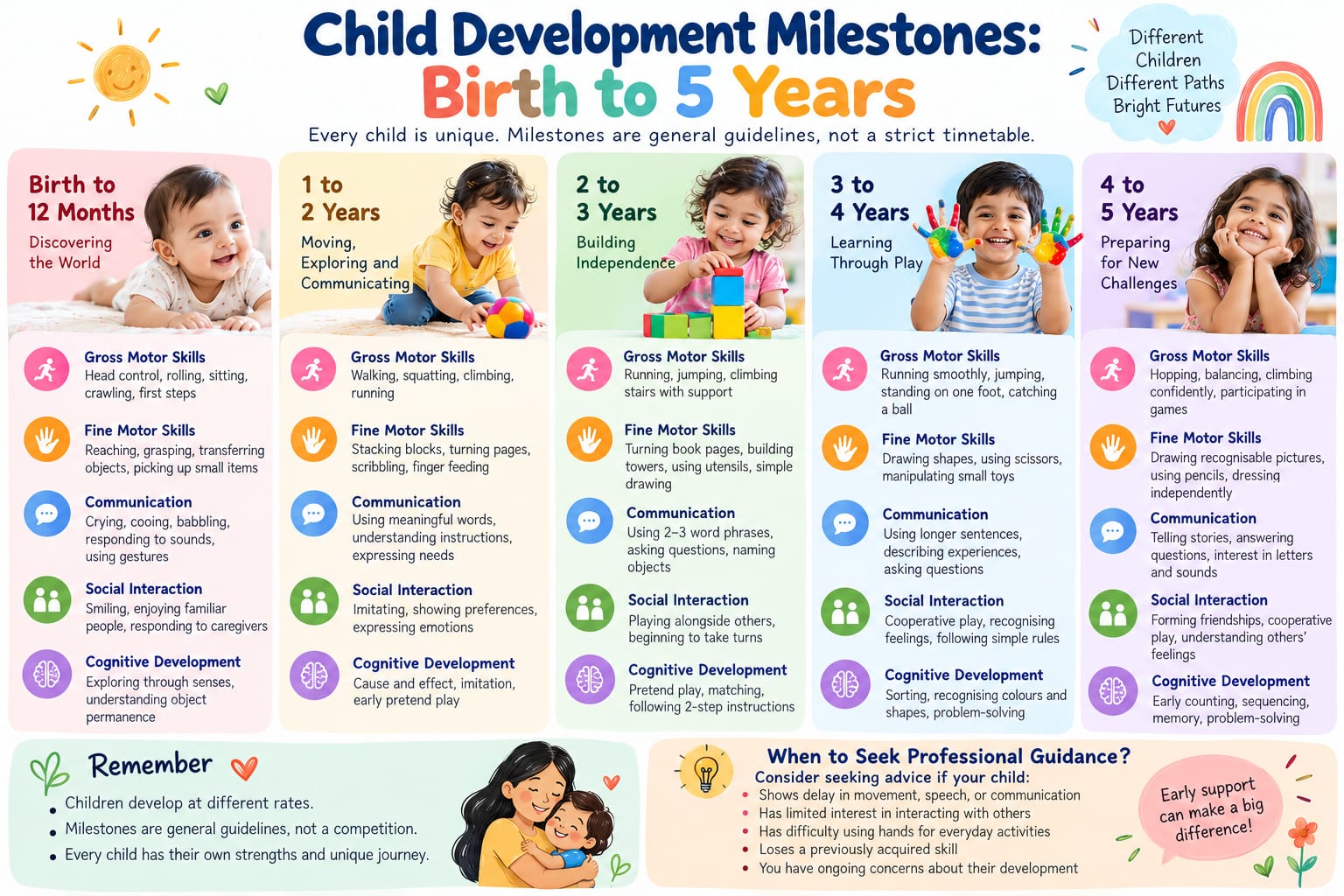
Your guide to learning, development and growing up, for your child
One of the best things about being a parent is seeing your child grow up. Every new skill is a cause for happiness and pride. From that first smile, to those first words, to those exciting first steps. As parents, as we move along we wonder, “Is my child developing normally?
Child development in all areas gross motor , fine motor , communication , social interaction and cognitive . These milestones help parents know how their child is doing, encourage learning at home, and when to get help.
Remember each child is individual. Milestones are general guidelines of development, not a race or schedule to be followed.
1. Birth to 12 Months: Discovering the World
Babies grow fast in the first year of life. They begin to notice the things around them, they respond to familiar faces, and they start the process of moving and speaking.
Motor Skills: They learn to control their heads, roll over, to sit up, first with help, then by themselves. Some start crawling, pulling themselves up or taking their first steps at the end of the first year. But crawling is not a milestone every baby will reach the same way.
Fine motor skills: A baby’s first grasp is a whole hand grip. They will start to grab toys, move things from one hand to the other and start to pick up small objects with their thumb and fingers with better co-ordination.
Communication: Early communication includes crying, cooing, babbling, and responding to familiar voices. Babies may turn their heads toward sounds, know their names, or use gestures such as reaching their arms toward a caregiver.
Social Interaction: Important early social skills include smiling at familiar faces, enjoying playful interactions, and responding to caregivers. Babies are becoming more and more communicative and interested in what is happening around them.
Cognitive Development: Learning Through the Senses They examine toys by looking at them, touching them, shaking them and sometimes putting them in their mouths. They learn over time that there are objects and people there when they can’t see them.
2. Moving, Exploring and Communicating 1-2 Years
Second year can be an exciting time of change. Toddlers grow more independent and curious.
Motor Skills : As children get better at balancing, bending down to pick up toys, getting on low furniture and trying to run, many learn to walk.
Fine Motor Development: Toddlers learn to stack blocks, turn pages in books, scribble with crayons, and eat with their fingers. They learn to master their hand by slow degrees.
Communication: They may begin to use words that have meaning and then string words together to say what they want. can say the common orders and the names of common objects.
Social Interaction: Toddlers like familiar faces and copy activities at home. They are beginning to develop likes and dislikes and feelings, but sharing and waiting and dealing with frustration can still be difficult.
Intellectual Development: Kids learn cause and effect, imitation of actions, and exploration of objects. You might see some simple pretend play (e.g., pretending to talk on a toy phone).
3. 2-3 Years: Developing independence
Children between two and three years are usually more active, expressive and interested in doing things themselves.
Motor Skills: Children usually improve at walking and running and begin to jump on two feet and try to climb stairs with help or supervision.
Fine motor skills: Turns pages of individual books, builds taller towers of blocks, uses simple utensils, and copies basic lines or scribbles.
Communication: Children start to string words together into little phrases or sentences and their vocabulary increases. They start asking questions. They name things that they know. They express their ideas more clearly.
Social Interaction: They may start out by playing with other children and then move on to simple shared play. They begin to learn how to take turns, but usually require a little help from an adult.
Intelligence Development: Children start to play pretend games, recognize familiar objects, identify simple patterns and follow simple two-step instructions. Usually people mean curiosity as questioning and exploring.
4. Play Based Learning for 3-4 Year Olds
This is when play gets more imaginative, and kids learn more advanced communication and problem solving skills.
Motor Skills: Most children can run, jump and climb more easily, and can try to balance on one foot. They may begin to catch a big ball and as they become more confident use more of the playground equipment.
Fine motor skills: Children learn to draw simple shapes, use child safe scissors with adult supervision, manipulate small toys and perform some dressing tasks.
Communication: Kids are forming longer sentences, linking experiences, posing questions. Their speech is more understandable to both familiar and unfamiliar listeners. Some speech sounds are still coming through.
Social Interaction: Role play becomes more complex, Children may start working with other children. They learn to recognize emotions, to follow simple rules and to resolve disputes with help.
Cognitive development: Children learn to sort objects based on their characteristics, recognize colors and shapes, understand simple concepts and solve age-appropriate problems by trial and error.
5. Four to Five Years: Preparing for Future Challenges
Children also tend to become more independent and develop skills allowing more formal learning at about five years of age.
Motor Skills: Many children can hop, balance on one foot for a short period of time, climb confidently and play simple games that involve running, jumping and throwing.
Fine motor skills: May be able to draw recognizable pictures, copy some letters or shapes, use pencils with more control, and dress more independently.
Communication: They can usually talk about what has happened, tell simple stories and answer questions and join in conversations. They may also start to hear rhymes, and ask about letters and sounds.
Social interaction: the play becomes complicated. Children can learn simple rules, make friends and be more aware of other people’s feelings.
Cognitive development: Young children develop early skills in counting , sorting , memory and problem solving . They can have multi-step routines, understand simple sequences, and be curious about how things work.
When to get professional help as a parent
Not every child will reach his/her milestones the same day. Some are up and moving early, but not talking until later. Some are very verbal before they feel steady enough to move around. Progress may be affected by differences in temperament, opportunity for practice, health, and individual development.
However, if a child: Parents should seek professional advice.
- Difficulty in controlling head, sitting, standing or walking, in comparison to expected developmental ranges. The child has any of the following symptoms.
Doesn’t respond to sounds, their name or familiar voices.
- Does not gesture or attempt to communicate or develop language in a meaningful way as expected.
- Shows little interest in playing with other children or with parents
- still has trouble using, grasping or exploring age-appropriate objects with hands
The child still has trouble exploring, grasping or manipulating age appropriate objects with their hands. activity, movement, routine
Watch for loss of skills once learned.Parents don't need to wait until a child is far behind or reaches a certain age to seek advice.
Depending on the concerns, a pediatrician or developmental specialist may refer for assessment to a physiotherapist, occupational therapist, speech and language therapist or other appropriate professional.
What parents can do at home
Every little thing you do every day counts. Read to, sing to and talk with your child. Promote safe floor play, moving, drawing, stacking blocks, pretend play and interaction with other kids. Let your children practice skills at their own level without pressure and reward them for effort as well as for success.
Most importantly, spend time watching what your child is interested in doing. Learning happens through play, and so does positive interaction.
Every child deserves the chance to thrive
Child development is a marathon, not a race. Milestones help parents understand what skills are likely to emerge as children grow, but they don’t determine the child’s potential.
If you have concerns about your child’s development, a professional can help you understand your child’s strengths, areas where additional support may be helpful, and other steps to take.
At Brain Tree Child Development Center, we believe that supporting a child’s unique developmental path begins with knowing their needs, recognizing their strengths and helping families make informed choices to move forward.
DISCLAIMER This article is for general educational information only and is not intended as a substitute for an individual developmental assessment. Developmental milestones are just guidelines. If you are concerned about your child’s development, contact a qualified health care provider.