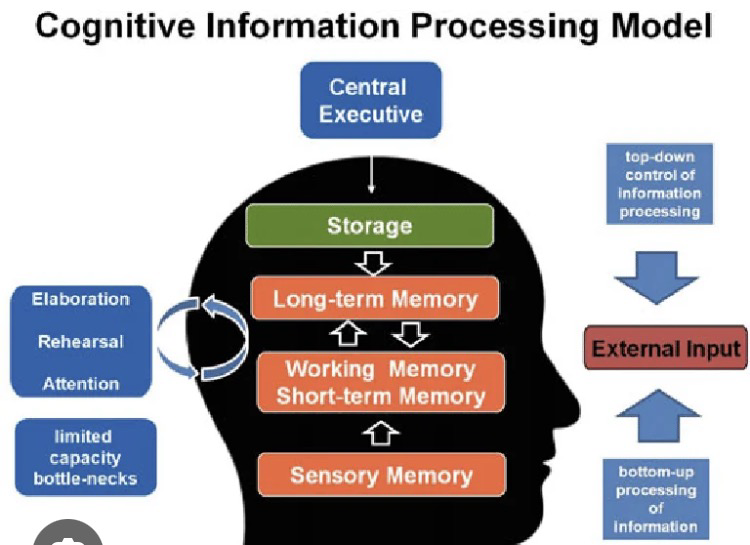
Cognitive Information Processing Theory
Cognitive Information Processing Theory (CIPT) explains how the human brain receives, processes, stores, retrieves and uses information to produce an appropriate response.
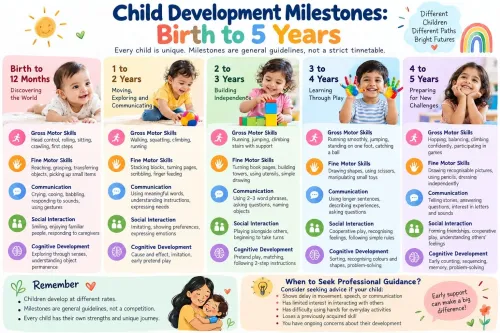
In children, this theory helps us understand how they learn, remember, understand instructions, solve problems and develop communication and motor skills.
1. Main stages of information processing
1. Sensory Input
Receiving information through vision, hearing, touch, smell and movement.
2. Attention and Perception
Selecting relevant information and understanding what it means.
3. Working Memory
Temporarily holding and manipulating information.
4. Processing and Decision Making
Comparing information, reasoning and selecting an appropriate response.
5. Response -Output
Producing a verbal, motor or behavioural response.
6. Feedback and Learning
Evaluating the response and modifying future performance.
2. Important components
Component Function
Attention Focuses on relevant information
Perception Interprets sensory information
Working memory Temporarily stores information
Long-term memory Stores learned knowledge and experiences
Processing speed Determines how quickly information is handled
Executive function Supports planning, inhibition and problem-solving
Retrieval Recalls previously learned information
3. Application in children with Autism (ASD)
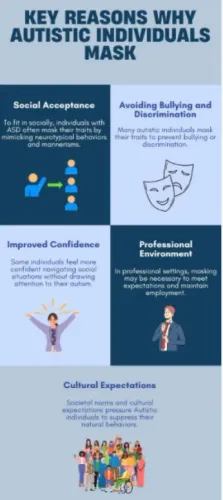
Children with ASD may show differences in some information-processing abilities.
* Attention: Difficulty shifting attention between activities.
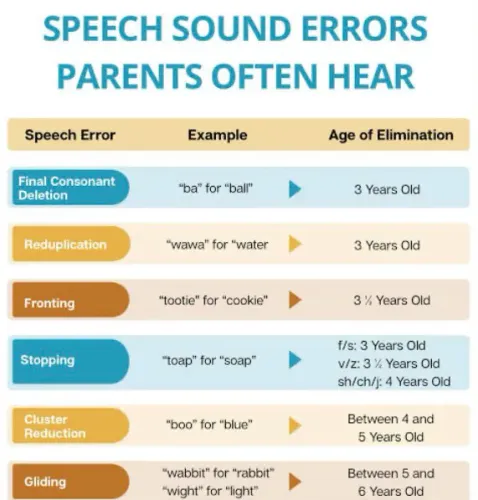
* Auditory processing: Difficulty understanding spoken instructions in noisy environments.
* Working memory: Difficulty remembering multi-step instructions.
* Processing speed: May require additional time to understand and respond.
* Cognitive flexibility: Difficulty adapting to changes in routines.
* Executive functioning: Challenges with planning, organising and problem-solving.
These characteristics vary considerably between children.
4. Clinical examples in paediatric therapy
Activity Cognitive skill involved
Following 2–3 step commands Working memory
Identifying different sounds Auditory perception
Matching pictures Visual processing
Obstacle course Motor planning and sequencing
Puzzle solving Problem-solving
Remembering object locations Memory and retrieval
Turn-taking games Attention and cognitive flexibility
5. Example: Processing a verbal instruction
When a therapist says, “Pick up the red ball and place it in the basket”:
* The child hears the instruction (sensory input).
* The child focuses on the therapist’s voice (attention).
* The child understands the words and their meaning (perception).
* The child remembers both steps (working memory).
* The child plans the sequence (decision-making and motor planning).
* The child picks up the ball and places it in the basket (motor output).
* The therapist provides feedback (learning).
6. Relevance to Physiotherapy and Occupational Therapy
Cognitive Information Processing Theory is useful for understanding the relationship between cognition, sensory information and motor performance.
It can guide therapists in:
* Designing graded learning activities.
* Improving attention and memory.
* Developing motor sequencing and praxis.
* Improving task performance.
* Encouraging independent functional activities.
* Promoting generalisation of learned skills.
Key takeaway: Cognitive Information Processing Theory explains how information travels from sensory input to meaningful action. In paediatric rehabilitation, understanding these stages helps therapists identify where a child may experience difficulty and plan appropriate interventions.
Keywords