Occupational Therapy for Kids: Learning Skills for Everyday Life
Helping children to feel more confident, capable and independent through everyday activities
Have you ever seen your child struggle to hold a pencil, use a spoon, button hisher shirt, or complete a simple puzzle? They might have difficulty sitting through an activity, handling their school supplies or playing with other children.
These are everyday activities which may seem simple to adults but involve several skills working together. Kids need hand control and coordination, attention, sensory processing and the ability to plan and carry out movements.
If a child has difficulty with these activities, pediatric occupational therapy can help him or her learn the skills needed to participate more comfortably and independently in everyday life.
Occupational therapy is more than simply teaching children how to write or hold objects. Its aim is to help them to engage in activities that have meaning for them, whether at home, school or play.
What is Occupational Therapy for Kids?
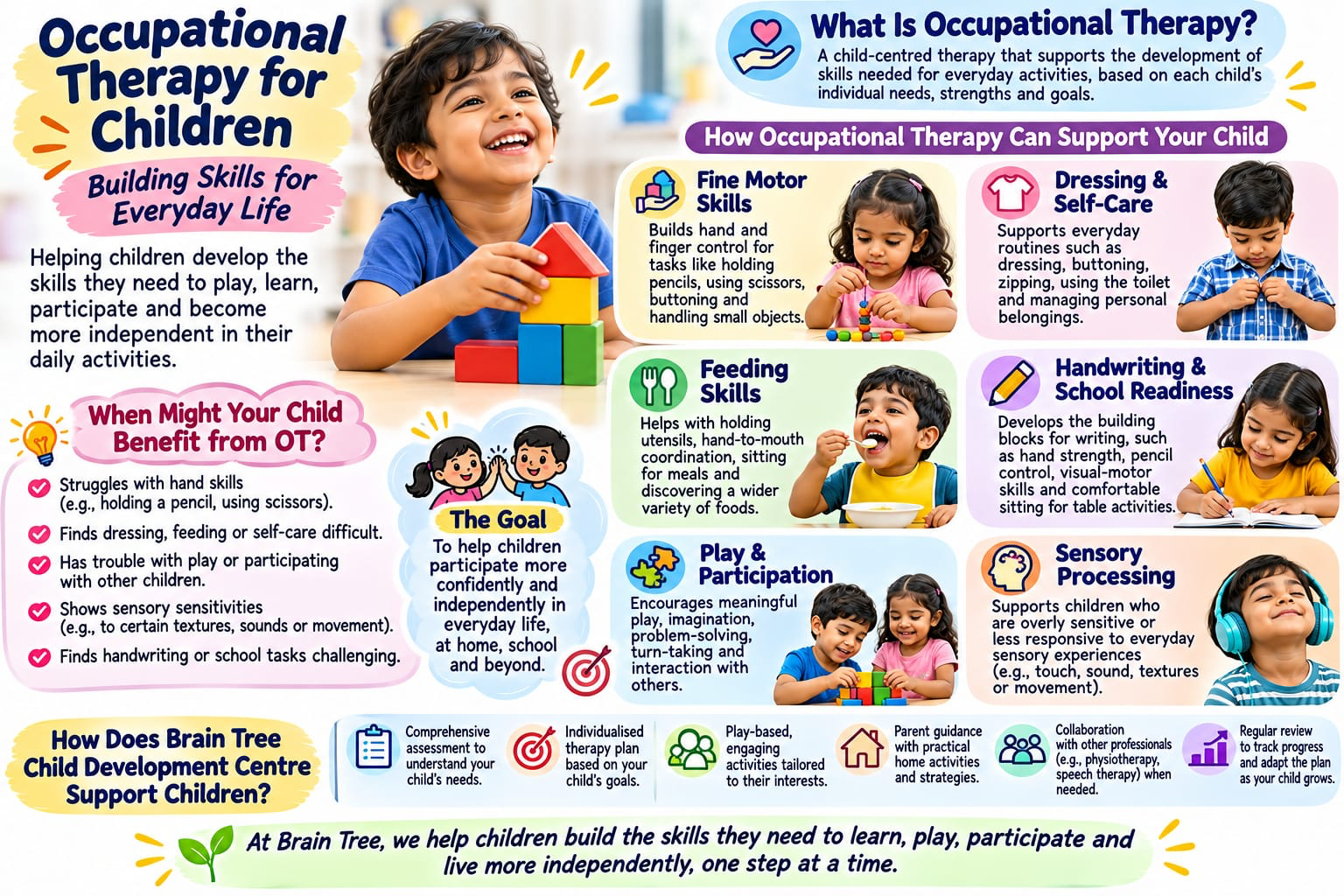
Pediatric occupational therapy is about helping children develop the skills they need for daily life.
An occupational therapist will evaluate how a child uses their hands, how they respond to sensory experiences, how they handle daily routines, play, learning and interacting with their environment.
If your child has difficulty with fine motor skills, self-care skills, handwriting, sensory processing, attention or participation in age-appropriate tasks, they may benefit from OT.
"Every child has his or her own strengths and challenges. So therapy is personalized to the child’s individual needs rather than the same program for everyone.
1. Building Fine Motor Skills
Fine motor skills are small movements of the hands and fingers. These skills are important for picking up toys, picking up objects, turning pages, drawing, cutting with scissors, and handling everyday materials.
Some children have difficulty holding a pencil comfortably, manipulating small objects, using both hands together, or doing things that require finger dexterity.
Occupational therapists can use activities such as:
- Construct block towers.
- Completing age-appropriate puzzles.
- Practice with finger movements and play dough.
- Under supervision, threading large beads.
- Pick up and arrange objects.
- Drawing, coloring and tracing simple forms.
These activities give opportunities to practice hand control and co-ordination in a fun way.
2. Helping with dressing and personal care skills
Putting on shoes, fastening buttons and managing zippers are important steps toward independence when getting dressed.
Some children may find these activities challenging as they require many skills including hand coordination, body awareness, motor planning and sequencing.
An occupational therapist can assist children by dividing their everyday tasks into smaller, more manageable parts and helping them practice these tasks little by little.
For example, if a child has difficulty getting dressed, they may start by practicing pulling up loose clothing before moving on to more complicated tasks like buttons or zippers.
Therapy may also focus on things such as brushing teeth, washing hands and managing personal effects.
The goal is to assist children in taking part in their daily activities with increased confidence and reduced reliance on caregivers.
3. Enhancing Feeding Skills
Mealtimes offer excellent opportunities for children to learn independence and family routines.
Some children may have difficulty holding a spoon, utilizing a fork, drinking from a cup, or controlling the movements needed to feed themselves. Some may have trouble with how their senses respond to the texture, smell, or temperature of food.
Occupational therapists may address:
- Requires hand control of utensils.
- Coordination of hand and mouth.
- Posture and positioning during eating.
• Gradual self-feeding involvement.
- Modifying utensils and mealtimes as appropriate.
- Supporting sensory challenges related to food.
The causes of feeding concerns vary. Depending on the child’s needs, collaboration with a pediatrician, speech and language therapist or feeding specialist may be necessary.
4. Developing Handwriting and School Readiness
There’s more to handwriting than holding a pencil. Children need hand strength, finger control, visual-motor coordination, posture and the ability to organize movements on paper.
Some children may find it difficult to copy shapes, stay within the lines, make letters, hold a pencil comfortably, or finish written classroom tasks.
Occupational therapy can facilitate handwriting readiness through activities like:
- Color and drawing.
- Copying simple lines and shapes.
- Practise movement of fingers and hands.
• Developing visual-motor skills
- Provide age-appropriate writing materials.
- Developing the ability to cope with schoolwork.
Keywords