Helping Young Voices: Developing Speech and Language Skills in Children
Helping with everyday communication, stories and play.Hearing your child say their first word is one of the most exciting moments for parents. To ask questions, to narrate stories, to express thoughts, to call “Amma” or “Appa” – all this is an integral part of childhood.
But communication is so much more than just talking. Kids communicate through facial expressions, gestures, sounds, body language and interactions with other people.
Some kids talk early, some kids take a little longer to get their communication skills going. Understanding how speech and language develop can assist parents in supporting communication at home and in recognizing when they might require professional assistance.
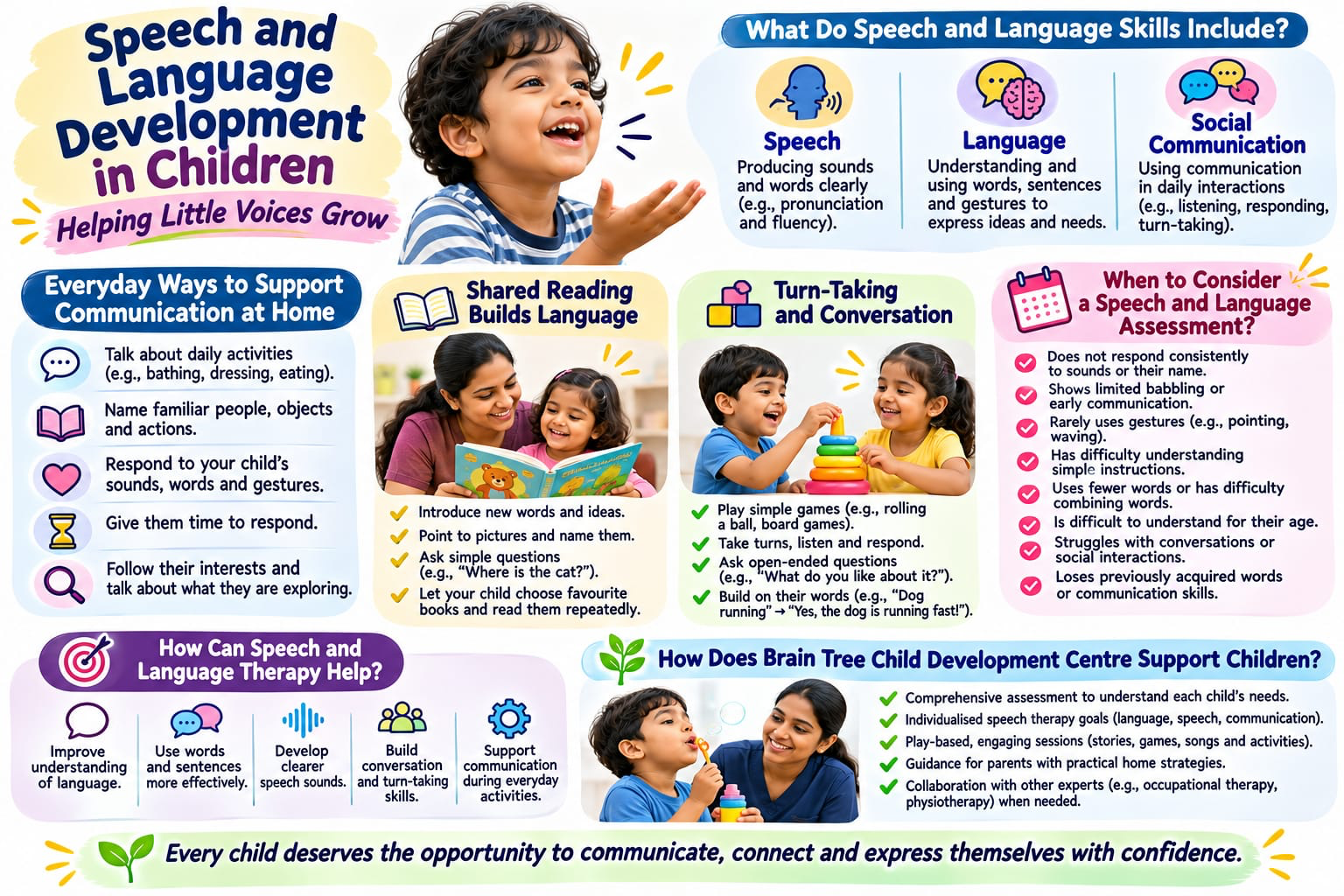
What Is Language and Speech Development?
Speech and language are related, but they are not the same thing.
-Talk: Ability to make sounds and words, including pronunciation, clarity and fluency.
- Language: How well a person understands and uses words, sentences, gestures, and other ways to communicate thoughts and needs.
- Social communication:Being able to communicate well when interacting. This includes listening, responding, sharing attention, taking turns.
A child may know what he should do but may have difficulty in expressing it in words. Another child may have a lot to say but struggle to keep up with conversations. It is important for professionals to know the differences to understand where each person needs help.
1. Communication Starts at Home Every Day
Children learn how to communicate through everyday interactions with parents and caregivers. Mealtimes are full of opportunities for learning – talking, naming things, describing what you are doing and responding to your child's attempts to communicate.
Simple habits parents can incorporate to encourage communication include:
- Discuss activities of daily living such as bathing, dressing, and eating.
- Identify familiar people, objects, animals and actions.
Respond to your child’s sounds, gestures, and attempts to communicate.
- Give your child enough time to answer.
- Participate in their interests and talk about what they’re exploring.
For instance, if your child points to a ball, you can say, “Yes, that’s a ball! The ball is now rolling. This links language to something that matters to the child.
2. Shared Reading Builds Language Skills
When you read together, you expose children to new words, sounds, ideas and stories. It also gives opportunity for parents and children to interact.
You don't have to wait until your child is able to read. Babies can enjoy bright picture books and hearing familiar voices.
Try these easy things:
- Point to pictures and name familiar objects.
- Read picture books and make animal sounds.
- Ask simple questions such as “Where is cat?”
Have older children tell the story of pictures.
- Choose a favorite book with your child and read it over and over for fun.
Reading should be enjoyable, not a vocabulary test. Encourage your child to point, make sounds, turn pages and talk about what interests them.
3. Learning Through Turn-Taking and Conversation
Communication is not just talking, it is also listening and answering. Children need to be able to express themselves and learn that conversations are about taking turns.
You can learn these skills by playing simple games.
For younger children, try rolling a ball back and forth, playing peekaboo or making sounds and having your child copy you. With older children try board games, make-believe play, and talk about the things they like to do.
Here are some ways parents can help to encourage discussion:
- Open questions
- Hear me out.
- Responding to the child’s utterance, without delay.
- Playing games in turns.
- Elaborating on the child’s utterance.
If your child says, “Dog running, ” you might respond, “Yes! The dog runs fast. This allows a longer sentence to be read in a natural way (without forcing the child to repeat it).
4. When should parents think about a speech and language assessment?
Kids don’t all develop communication skills at the same pace. Some problems may indicate that a professional evaluation would be helpful,
If your child talks about your concerns with a trained health care professional
- Does not consistently respond to sounds or hisher name.
- Little babbling, or attempts to communicate.
- Rarely uses gestures such as pointing, waving or showing.
- Has difficulty understanding common words or simple directions.
- Uses less language than expected for their developmental level.
Language is coming and struggling to make words join.
- Is more difficult to understand than would be expected for their age.
- Difficulty in speaking to people or asking about their needs.
- Still has difficulties with social communication.
If you observe a loss of communication skills previously achieved, such as words or gestures, get an immediate medical evalua
Keywords