Pediatric Physiotherapy: Helping independence and movement
Helping children get around, discover, play and grow with confidence
For every parent, it is a special experience to watch a child take their first steps, climb onto a chair, run across a playground or learn to jump. These everyday movements may seem simple but they require a number of skills working together, such as muscle strength, balance, coordination and body control.
“Not all kids develop these skills at the same pace. Some children may require extra help to learn movement skills, deal with physical challenges or take part in everyday activities. This is where paediatric physiotherapy can help.
Pediatric physiotherapy helps infants, children and adolescents to develop functional movement according to their individual needs. “We are not trying to get children to a developmental milestone, but to be able to participate in their daily lives in a more comfortable, confident way.
What is Pediatric Physiotherapy?
Pediatric physiotherapy is a branch of physiotherapy that focuses on the movement and physical development of children.
Children may have physiotherapy for many reasons such as delayed motor milestones, neurological conditions, orthopedic issues, tone differences, difficulties with movement or physical participation.
When planning an intervention, a pediatric physiotherapist will take into account the child's age, developmental stage, medical history, current abilities and family concerns.
Pediatric physiotherapy differs from adult rehabilitation in that it uses play, movement games and activities appropriate to the child’s age to encourage the child to practice skills in an enjoyable environment.
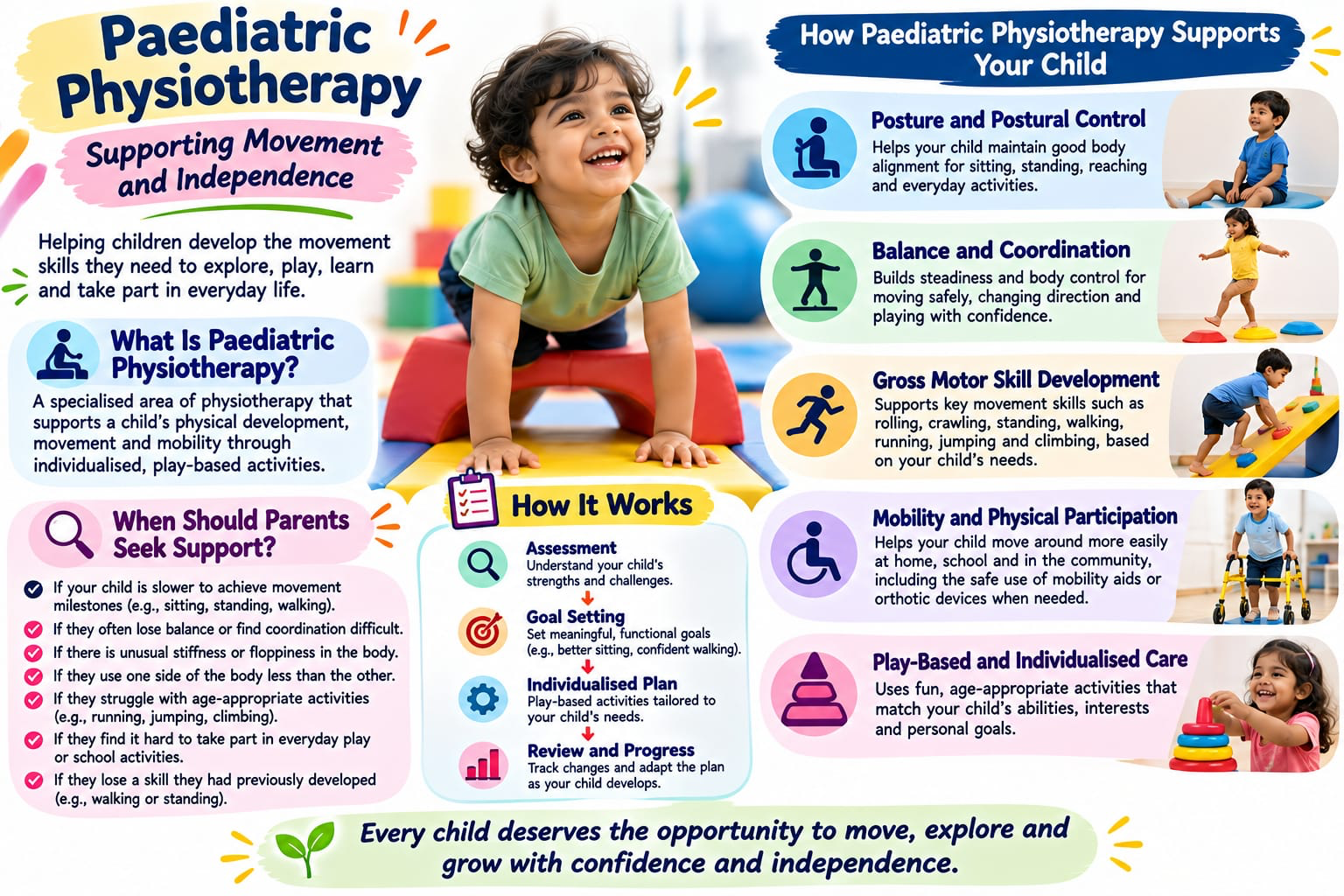
1. Improvement of Postural and Postural Control
Posture affects how children sit, stand, reach and interact with their environment. Some children may have difficulty sitting upright, maintaining trunk stability or maintaining stability when reaching for toys.
A physiotherapist will look at how the child holds different positions and if muscle strength, tone or postural control affect everyday activities.
The therapy may consist, depending on the assessment, of:
- Activities that promote head and trunk control.
- Free and supported sitting practice.
- Exercises for postural stability.
- Activities to reach in different positions.
- Suggestions for suitable positioning for day-to-day activities.
The goal is to help children reach functional positions that allow them to participate in play, learning and self-care activities.
2. Building Your Balance and Coordination
Balance and coordination help children safely navigate their environment. These skills are important when you are walking on uneven surfaces, climbing stairs, playing with a ball, or participating in playground activities.
Some of the children may seem a little unsure of themselves when they move around and may often lose their balance or have difficulty coordinating their arms and legs.
A pediatric physiotherapist may introduce activities such as:
- Over low obstacles.
- Walking on floor markings.
-getting up and going to things.
- Ball activities appropriate for age.
- Navigate Simple Obstacle Course.
- Activities that involve controlled stepping and changing direction.
Activities are gradually adapted to the child’s increasing confidence and skill.
3. Building Gross Motor Skills
Gross motor skills are larger movements using large muscles. These include rolling over, sitting, crawling, standing, walking, running, jumping and climbing.
Some children may take longer to develop these abilities or may find some movements more difficult than others.
The physiotherapist will decide which skills need working on and will choose activities that are appropriate to the stage of development of the child after the assessment.
Intervention may aim at:
- Practicing transitions between positions, e.g., sitting to standing.
- Performing floor mobility and crawling as directed.
- Enhancing walking and running abilities.
- Developing skills in jumping, hopping and climbing.
- Encouraging participation in playground activities of an appropriate age group.
The emphasis is on functional movement rather than on every child following the same developmental pathway.
4. Increasing Mobility and Physical Engagement
Mobility is not just walking. This is getting off the floor, moving from room to room, going up and down stairs, getting onto playgrounds and engaging in activities outside the home.
Children with physical or neurological difficulties may need extra help to do these things.
Physiotherapy can address walking patterns, transfers, muscle strength, endurance, and the appropriate use of mobility aids or orthotic devices where clinically indicated.
If children need extra equipment, the physiotherapist may work with the family and other health professionals to find suitable options.
The overall goal is to decrease barriers to movement and
Keywords