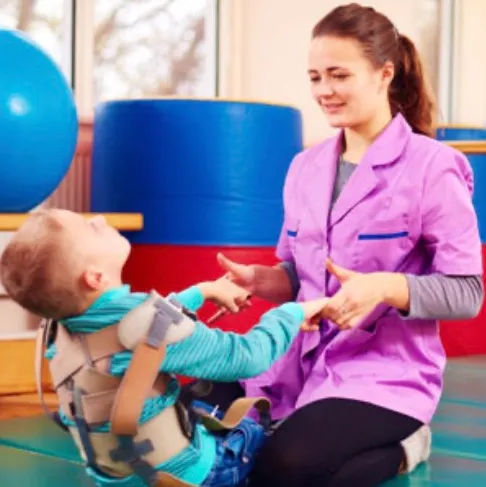
Global developmental delay (GDD) means a young child is significantly behind expected milestones in two or more areas of development (for example: gross motor, fine motor, speech-language, cognition, and social–emotional). In newborns and infants, “early physio” (early physiotherapy-early intervention) is important because the first months–years of life are a period of very high brain plasticity, so timely, targeted movement and sensory experiences can strongly influence long‑term outcomes.
## What is global developmental delay in infants?
- GDD is used for children under about 5 years who show **significant delay in ≥2 developmental domains** (often defined as ≥2 standard deviations below the mean).
- In practice, for a newborn-young infant this may look like:
- Poor head control, very floppy or very stiff tone, asymmetrical movements.
- Not tracking faces-objects, limited social smile, poor feeding-suck.
- Later: not rolling, sitting, babbling, or responding to name at expected ages.
Common causes include prematurity, birth complications (lack of oxygen), genetic-chromosomal conditions, congenital infections, metabolic disorders, and sometimes unknown causes.
## Why early physiotherapy matters in newborns-infants
Early physiotherapy doesn’t “force” milestones; it uses gentle, play‑based activities and caregiver coaching to shape normal movement patterns while the brain is most adaptable.
Key reasons it’s emphasized:
### 1. Critical window of neuroplasticity
- The first year (especially the first 1000 days from conception) is a **high‑plasticity window** when neural circuits for movement, posture, and coordination are being built.
- Targeted sensory and motor input during this time can help “wire” more efficient pathways and compensate for early injury or immaturity.
### 2. Better motor outcomes, especially in high‑risk babies
- In preterm and other high‑risk infants, structured early physiotherapy is associated with:
- Improved motor development closer to expected age.
- Better head control, rolling, sitting, and walking timelines.
- Improved feeding and reduced long‑term developmental delay.
- Early, individualized programs (sometimes starting in NICU or soon after discharge) that include positioning, passive-active exercises, sensory stimulation, and family‑led activities show meaningful gains in motor and sometimes cognitive domains.
### 3. Prevention of secondary problems
Early physio helps prevent complications that can lock in delays:
- Reduces persistent muscle tightness, asymmetry, and abnormal movement patterns.
- Helps manage conditions like **torticollis** (neck tightness) and **positional plagiocephaly** (flat head), which are common in infants and strongly linked to motor delay if untreated.
- Supports symmetrical strength and posture, making later skills (sitting, crawling, walking) easier to learn.
### 4. Family empowerment and everyday practice
- Early intervention is most effective when **caregivers are coached** to embed exercises into daily routines (feeding, bathing, play, tummy time).
- This increases the “dose” of therapy without over‑medicalizing the infant’s day and reduces parental anxiety by giving clear, doable strategies.
## What early physio for a newborn-young infant may include
Depending on the baby’s needs, a pediatric physiotherapist might:
- Assess muscle tone, reflexes, symmetry, and early motor patterns.
- Teach positioning and handling to promote midline orientation and symmetrical movement.
- Guide safe tummy time, side‑lying play, and age‑appropriate reaching-rolling activities.
- Use gentle passive range‑of‑motion, stretching (e.g., for torticollis), and sensory stimulation.
- Advise on feeding posture, equipment (e.g., supportive seats), and home exercise programs.
Therapy can start **from day one** in high‑risk infants (e.g., very preterm, NICU graduates, babies with known neurological risk), and continues with regular review as the child grows.
## When to seek early assessment
Red flags that warrant prompt evaluation by a pediatrician and, if needed, a pediatric physiotherapist include:
- Very floppy or very stiff body; persistent fisting after 3 months.
- Poor head control by ~3–4 months, not rolling by ~6 months, not sitting by ~8–9 months.
- Strong preference to look one way, persistent head tilt, or obvious asymmetry.
- Limited eye contact, no social smile by ~2–3 months, or loss of previously acquired skills.
Keywords